If your heat pump is blowing cold air in winter in Ottawa, the most likely cause is a normal defrost cycle - your system periodically reverses for 5 to 15 minutes to melt frost off the outdoor coil, and during that window the indoor unit stops delivering heat. If the cold air lasts longer than 15 minutes, or the indoor fan keeps running while the outdoor unit sits silent, you have a real fault: low refrigerant, a failed reversing valve, a dead backup heat element, or a thermostat misconfiguration.
That is the whole answer. The rest of this post walks through how to tell the two apart, what each failure actually looks like on an Ottawa January morning, and when it is worth picking up the phone.
The short answer: normal defrost vs. a real fault
Ottawa heat pump cold air in winter Ontario is a search that spikes every year between December and February, and roughly half the calls we get about it end with the homeowner learning their system is working exactly as designed.
A cold-climate heat pump absorbs heat from outdoor air - even at -25°C, there is still usable heat energy in it. But when the outdoor coil drops below freezing, frost builds on the fins and blocks airflow. The system switches into defrost mode, briefly runs in reverse to warm the coil, and dumps the melted water out the bottom. During defrost, the indoor blower either stops or runs at low speed, and the air at your registers can feel cool for 5 to 15 minutes.
The tell is duration and frequency. A healthy system defrosts every 30 to 90 minutes in humid cold weather, for under 15 minutes each time. A system that blows cold for 30 minutes straight, or defrosts every 10 minutes, is not healthy.
Why is my heat pump blowing cold air in Ottawa winter?
Ottawa winters push heat pumps harder than almost anywhere in Canada. Environment Canada data for the city shows January daily lows averaging around -14°C, with cold snaps dropping to -25°C or lower for days at a time. That is well inside the operating range of a modern cold-climate unit, but it is also the range where small problems become obvious.
Here is the honest breakdown of what we find on service calls in this city:
- Defrost cycle running normally - accounts for about half of "cold air" complaints. No repair needed.
- Auxiliary heat not engaging - the single most common real fault. The heat pump is fine; the backup strips are not.
- Low refrigerant charge - usually from a slow leak at a flare fitting or a failed Schrader valve.
- Reversing valve stuck - the system is running in cooling mode when it should be heating.
- Thermostat or control wiring issue - the system does not know it is supposed to be heating.
- Outdoor unit iced over and not clearing - blocked drainage, failed defrost board, or snow packed against the cabinet.
If you have a ducted system and you are seeing this pattern, it is worth understanding how the indoor air handler interacts with defrost before you assume the worst - our team covers that in detail under Heat Pump Air Handler Installation in Ottawa, Ontario.
Is it normal for a heat pump to blow cold air in Ottawa?
Yes - briefly, and only during defrost. Here is how to tell normal from not normal without tools.
Normal defrost behaviour
- Cold air lasts 5 to 15 minutes, then warm air returns.
- You may see steam or water vapour rising off the outdoor unit - that is normal, it is the coil shedding frost.
- The outdoor fan stops while the compressor keeps running.
- Water drips from the base pan onto the pad or ground below.
- The cycle repeats every 30 to 90 minutes in humid cold weather.
Not normal
- Cold air for more than 20 minutes with no recovery.
- The indoor fan runs continuously but the air never warms up.
- The outdoor unit is silent - no compressor, no fan.
- A thick block of ice forms on the coil and does not clear after a defrost cycle.
- The thermostat shows the system calling for heat but the auxiliary heat indicator never lights.
If you are seeing the second list, stop reading and call. If you are seeing the first, note the time and check again in 20 minutes.
The real faults that cause cold air in an Ottawa winter
Auxiliary heat not engaging
Every heat pump installed in Ottawa should have a backup heat source - usually electric resistance strips in the air handler or a dual-fuel setup with a gas furnace. When the heat pump goes into defrost, the backup heat is supposed to carry the load so you do not feel the cold. If the strips are burned out, the breaker is tripped, or the sequencer has failed, you feel every defrost cycle as a blast of cold air.
This is the fault we fix most often in January. A failed 10 kW heat strip set is a same-day repair, and it is the difference between a comfortable house and a miserable one. If your home was originally heated with electric baseboards and you added a heat pump, the backup heat configuration matters even more - see Heat Pump Installation for Homes with Electric Baseboard Heating in Ottawa, Ontario for how that is set up properly.
Low refrigerant charge
A heat pump with a slow refrigerant leak will still run, but it will not extract enough heat from outdoor air to keep up. In mild weather you might not notice. At -20°C, the system runs constantly, the discharge air temperature drops to near room temperature, and it feels like cold air.
Signs: the outdoor coil frosts unevenly (patchy white instead of uniform), the compressor runs longer than usual, and your hydro bill climbs. A technician with gauges and a leak detector can confirm this in about 30 minutes.
Reversing valve stuck in cooling
The reversing valve is the part that lets a heat pump switch between heating and cooling. When it sticks - usually from a failed solenoid coil or a mechanical jam - the system runs in cooling mode year-round. You will feel cold air from the registers, the outdoor unit will run, and the house will get colder the longer it runs.
This is not a DIY fix. The valve is brazed into the refrigerant circuit and requires recovery, replacement, and recharge.
Thermostat or control wiring
Modern heat pump thermostats need to be configured for the specific system - staging, backup heat lockout temperature, defrost behaviour. If the thermostat was replaced or reset and the configuration is wrong, the system may never call for auxiliary heat, or it may run the fan in "on" mode continuously, circulating cool air from the ducts.
Check the thermostat first. It is the cheapest thing to rule out.
Outdoor unit buried or blocked
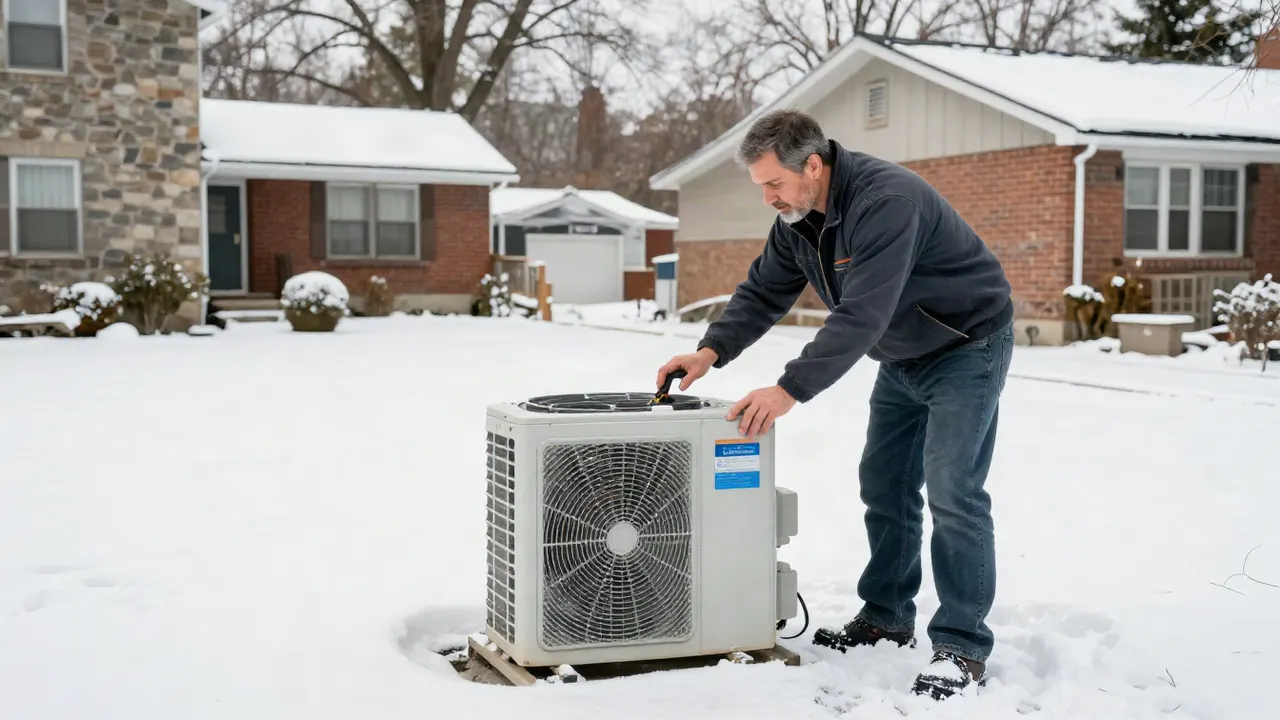
Ottawa snow clearing can pile snow against the outdoor unit, blocking airflow and preventing defrost from clearing the coil. Keep 60 cm of clearance on all sides and 1.5 m above. If the unit is on a stand, make sure the base pan drain holes are clear - a plugged drain turns into an ice block that jams the fan.
How to check your system before you call anyone
Run through this in order. It takes about 10 minutes and rules out the easy stuff.
- Check the thermostat. Confirm it is set to HEAT, the setpoint is at least 2°C above room temperature, and the fan is set to AUTO, not ON.
- Wait 15 minutes. If the air warms up, you caught a defrost cycle. Nothing to fix.
- Look at the outdoor unit. Is the fan running? Is there ice on the coil? Is snow packed against it?
- Check the breaker panel. Heat pumps usually have two breakers - one for the outdoor unit, one for the air handler and backup heat. Reset any tripped breaker once. If it trips again, stop and call.
- Check the air filter. A clogged filter restricts airflow and can trigger a high-limit lockout on the backup heat. Replace if it is grey.
- Check the auxiliary heat indicator. On most thermostats, a small light or icon shows when backup heat is running. If it never comes on during a cold snap, the strips or the control circuit are suspect.
If you get through that list and the air is still cold, you have a refrigerant, valve, or control fault. Those need gauges and a multimeter.
Common mistakes Ottawa homeowners make in cold snaps
We see the same handful of errors every winter, and most of them make the problem worse.
- Setting the thermostat back at night. Heat pumps recover slowly. A 3°C setback overnight means the backup heat runs for an hour in the morning, and you feel cold air while it catches up. In Ottawa, keep the setpoint steady and let the heat pump modulate.
- Switching to EM HEAT and leaving it there. Emergency heat bypasses the heat pump entirely and runs the strips. It works, but it costs roughly two to three times as much to run. Use it only until a technician arrives.
- Turning the system off to "reset" it. A heat pump that is off in -20°C weather loses ground fast. Leave it running.
- Clearing snow with a shovel against the cabinet. You can bend the fan blades or puncture the coil. Use a broom, and stay 60 cm back.
- Ignoring a slow decline. A system that felt fine in November but struggles in January usually has a refrigerant or backup heat issue that has been developing for weeks.
If your system is more than 12 to 15 years old and this is the second or third winter you have dealt with cold air complaints, the math often favours replacement over another repair. Our team walks through that decision under Heat Pump Replacement in Ottawa, Ontario.
When to call a professional
Call a technician the moment you confirm the air is cold for more than 20 minutes, the breaker trips twice, you see ice that will not clear, or the auxiliary heat indicator never lights during a cold snap. Those four symptoms cover every serious fault we see, and none of them are safe or sensible to diagnose without refrigerant gauges and a clamp meter.
We run service calls across the city all winter, and we see the same pattern in the newer suburbs - homes in Heat Pump Installation in Kanata built in the last 15 years often have undersized backup heat because the original builder sized the strips for a milder climate zone. A 20-minute diagnostic tells you whether you are looking at a $300 repair or a $3,000 one.
If you are not sure whether your system is behaving normally, describe what you are seeing and we will tell you honestly whether it is worth a visit.
Frequently Asked Questions
Why is my heat pump blowing cold air in Ottawa winter?
Most often it is a normal defrost cycle lasting 5 to 15 minutes. If cold air persists past 20 minutes, the cause is usually failed backup heat strips, low refrigerant, a stuck reversing valve, or a thermostat misconfiguration.
Is it normal for a heat pump to blow cold air in Ottawa?
Yes, briefly. During defrost, the indoor unit stops delivering heat for 5 to 15 minutes while the outdoor coil melts frost. You may see steam off the outdoor unit. Cold air lasting longer than 20 minutes is not normal.
Should I call a heat pump technician in Ottawa Ontario?
Call if cold air lasts more than 20 minutes, the breaker trips twice, ice will not clear from the outdoor coil, or the auxiliary heat indicator never lights. Those four symptoms point to faults that need gauges and a multimeter.
How do I fix a heat pump blowing cold air in Ottawa?
Check the thermostat is on HEAT with fan on AUTO, wait 15 minutes for defrost to finish, confirm the outdoor unit is running and clear of snow, reset any tripped breaker once, and replace a clogged filter. If air is still cold, call a technician.
Does a heat pump work at -25°C in Ottawa?
Modern cold-climate heat pumps rated for Ottawa operate down to -25°C or lower, though capacity drops as temperatures fall. Below the balance point, backup heat carries the load. If backup heat fails, you feel cold air at the registers.
Get help with Heat Pump Installation in Ottawa
If your heat pump is blowing cold air and you have ruled out the easy causes, we can diagnose it fast - and if the system is at the end of its life, we will tell you straight rather than sell you another repair. Call Ottawa Heat Pump at 333-444-888 and we will get your house warm again.