
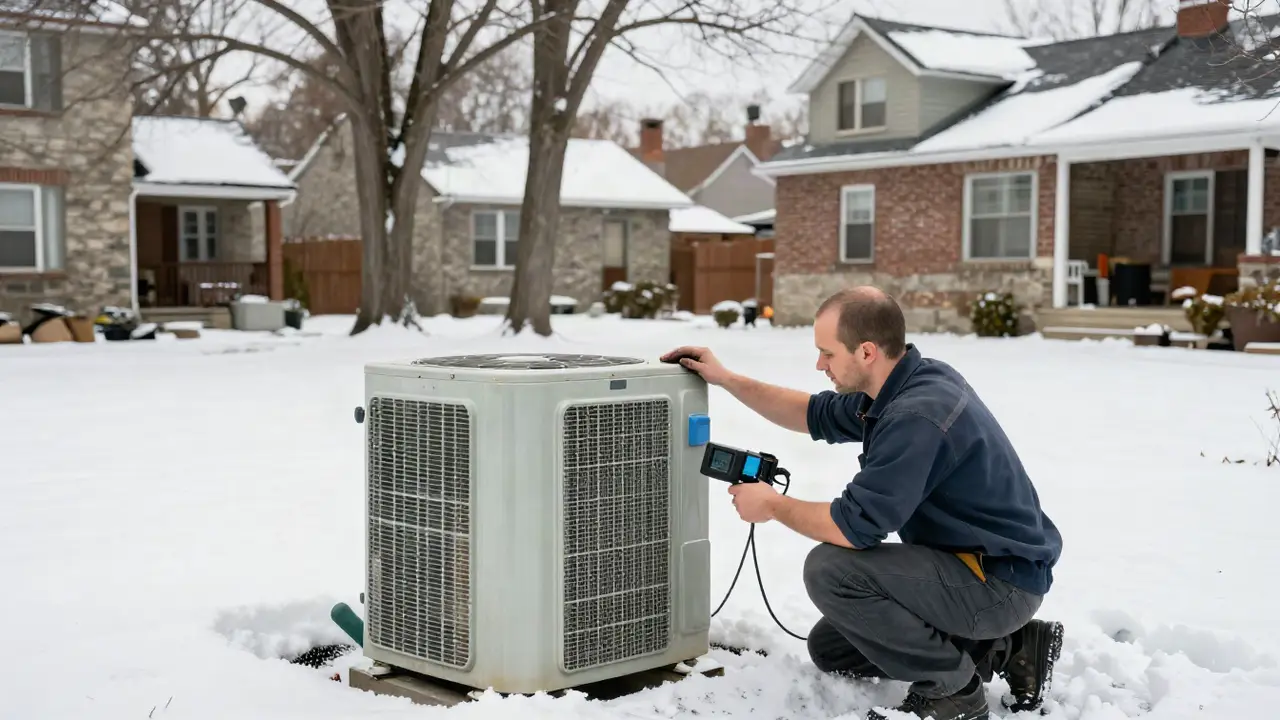
A cold climate heat pump keeps producing useful heat at -30°C, while a standard heat pump loses capacity steadily below -8°C and hands most of the work to electric backup heat once Ottawa hits its January cold snaps. That single difference - rated capacity at low ambient temperature - decides whether your hydro bill stays flat or doubles every time the temperature drops past -20°C. Cold climate heat pump vs standard heat pump in Ottawa winters is really a question about two things: how much heat the unit delivers when it is coldest outside, and how much electricity it burns doing it.
Below we break down the actual numbers, what we see on installs across the city, and how to tell which system belongs in your house.
The short answer for Ottawa homeowners
For an Ottawa home, a cold climate heat pump is the correct choice in almost every case, because Environment Canada records roughly 12 to 15 nights per winter where the overnight low drops below -20°C, and standard heat pumps are not built to carry a house through those nights on their own.
A cold climate heat pump is an air-source system engineered with an inverter-driven compressor and vapour-injection circuit that maintains rated heating capacity down to -25°C or -30°C, depending on the model. A standard heat pump is the older single-stage or fixed-speed design that was common in Ontario before 2015 - it produces its rated heat at 8.3°C and loses roughly 30 to 50 percent of that capacity by the time the outdoor temperature hits -15°C.
In practical terms: a cold climate unit runs the house. A standard unit runs the house until it gets genuinely cold, then a 10 kW or 15 kW electric resistance strip in the air handler takes over and your meter spins accordingly.
What actually separates a cold climate heat pump from a standard one
The difference is not marketing - it is compressor technology, refrigerant choice, and how the unit manages defrost cycles when the outdoor coil is buried in snow and ice.
Compressor and refrigerant
Cold climate units use inverter compressors that modulate between roughly 20 and 120 percent of rated capacity, plus vapour injection to keep the refrigerant mass flow up when the pressure ratio gets extreme. Most current models run R-32 or R-454B refrigerant, both of which have better low-temperature behaviour than the R-410A in older standard units.
Standard heat pumps cycle on and off at full speed. Every time the compressor restarts in -18°C air, it draws a hard inrush of current, and the system spends the first few minutes of each cycle just getting back to steady state. That is where the efficiency loss compounds.
Defrost logic
Every air-source heat pump frosts its outdoor coil. What matters is how it clears the frost. A cold climate unit uses demand-based defrost - it only reverses when sensors confirm frost has actually built up. Older standard units often run timed defrost, reversing every 30 to 90 minutes whether they need to or not. Each unnecessary defrost cycle is 3 to 8 minutes of the system pulling heat out of your house instead of putting it in.
Rated capacity at low ambient
Manufacturer spec sheets list heating capacity at -15°C, -20°C and -25°C. That is the number to compare, not the headline "up to 12 HSPF2" figure. A cold climate unit might hold 92 percent of its 8.3°C capacity at -20°C. A standard unit might hold 55 percent. Same nominal tonnage, wildly different real-world output.
How cold can a standard heat pump work in Ottawa Ontario?
A standard heat pump will physically run down to about -15°C to -20°C, but it stops being cost-effective well before that - usually around -8°C to -10°C, where its coefficient of performance drops close to 1.0 and it is essentially matching electric baseboard for efficiency.
Ottawa's design temperature for heating load calculations is -24°C. That is the number engineers use to size a system so it can keep your house at 21°C on the coldest expected night. A standard heat pump sized for that load would have to be enormous - and oversized units short-cycle in mild weather, which wrecks efficiency the rest of the year.
So in practice, a standard heat pump in Ottawa is paired with a large electric backup. It carries the house from October through early December and again in March and April. From roughly mid-December to late February, the backup does most of the work. You get the shoulder-season savings and almost none of the deep-winter savings.
If you already own a standard heat pump and it is struggling, that is a different conversation than a new install - we cover the options on our heat pump replacement page.
Real operating costs through an Ottawa heating season
Typical 2026 pricing in Ottawa puts a cold climate heat pump install at $9,500 to $18,000 before rebates, and a standard heat pump at $6,500 to $11,000 - but the sticker gap is not where the real money sits.
Here is the rough arithmetic for a 2,000 sq ft Ottawa home with a heating load around 55,000 BTU/hr at design temperature, using a blended hydro rate near 15 cents per kWh:
- Cold climate heat pump, whole season: roughly 9,000 to 11,500 kWh of heating electricity, about $1,350 to $1,725.
- Standard heat pump with electric backup: roughly 14,000 to 18,000 kWh, about $2,100 to $2,700, because the backup strips run at a COP of 1.0 for a meaningful chunk of January and February.
- Electric baseboard only (for comparison): roughly 19,000 to 22,000 kWh, about $2,850 to $3,300.
Over a 12 to 15 year service life, that gap is $8,000 to $15,000 in operating cost. It dwarfs the upfront difference.
Rebates shift the math further. The federal Canada Greener Homes program and Ontario's current heat pump incentives both pay more per tonne for cold climate equipment than for standard units, and Enbridge and Hydro Ottawa top-ups have historically added another $1,000 to $2,500 on qualifying installs. A properly documented cold climate install can land within $1,500 to $3,000 of a standard unit after rebates - and then save you $700 to $1,000 a year.
Which heat pump is best for Ottawa winters?
For Ottawa winters, the best heat pump is a cold climate air-source unit with a rated capacity at -25°C that meets or exceeds your home's design heating load, paired with a properly sized air handler and a modest backup heat source.
That is a mouthful, so let's unpack it. Three things have to line up:
- Rated capacity at -25°C must cover your calculated load. If your home needs 48,000 BTU/hr at -24°C and the unit only delivers 34,000 BTU/hr at -25°C, you are short by 14,000 BTU/hr and the backup runs hard.
- Turndown ratio should be at least 4:1 so the unit can run low and slow in October and April without short-cycling.
- The rest of the system - air handler, ductwork, controls - has to be matched to the outdoor unit. A great heat pump on undersized ducts performs like a mediocre one.
For homes without ductwork, or for additions and upper floors that never get warm, a ductless mini-split heat pump installation delivers the same cold climate performance zone by zone, with no duct losses at all.
Sizing, ductwork, and backup heat: where Ottawa installs go wrong
Most underperforming heat pumps in Ottawa were sized by rule of thumb - "about a tonne per 500 square feet" - instead of a real load calculation, and that single shortcut causes more comfort complaints than any equipment choice.
We run a room-by-room load calculation on every job. It accounts for window area and orientation, insulation levels, air leakage, and the fact that a 1950s bungalow in Alta Vista and a 2018 build in Riverside South have almost nothing in common thermally. The output is a BTU/hr number at Ottawa's -24°C design temperature, and that number - not square footage - picks the equipment.
Ductwork matters just as much. Older Ottawa homes often have 5-inch round branches sized for a furnace that ran at 60°C supply air. A heat pump delivers air at 35°C to 45°C, so it needs more airflow to move the same heat. Undersized ducts mean cold rooms, high static pressure, and a system that never reaches its rated efficiency. Sometimes the fix is a few branch replacements; sometimes it is a full rework, which we handle through heat pump ductwork modification and installation.
Backup heat is the third piece. Every cold climate install in Ottawa should have some form of auxiliary heat for the handful of nights below the unit's rated range and for defrost cycles. The right amount is usually 5 to 10 kW, staged so it only comes on when the heat pump genuinely cannot keep up - not as a default second stage.
Common mistakes we see on Ottawa heat pump installs
These are the recurring problems we get called to fix on systems other contractors installed across the city.
- Buying on HSPF2 alone. The headline efficiency rating is measured at mild temperatures. It tells you almost nothing about -22°C performance. Ask for the capacity table.
- Oversizing to "be safe." A unit that is 40 percent too big short-cycles all spring and fall, wears out faster, and dehumidifies poorly in summer.
- Setting the backup heat to come on at -10°C. That is a lockout setting, not a design limit. Modern cold climate units should be allowed to run to -20°C or lower before strips stage in.
- Snow and ice blocking the outdoor unit. A heat pump needs 18 to 24 inches of clearance under and around it. We see units buried to the fan grille after a February storm, which chokes airflow and forces defrost failures.
- No load calculation on file. If your installer cannot show you the BTU/hr number they sized to, they guessed.
- Ignoring the electrical panel. A cold climate heat pump plus 10 kW of backup can push a 100-amp service to its limit. We check the panel before quoting.
When to call a professional
Call a professional before you buy the equipment, not after - the sizing decision is the one that determines whether the system works, and it cannot be reversed cheaply once the unit is on the wall.
If you are comparing quotes and one of them does not include a room-by-room load calculation, a capacity table at -25°C, and a written backup heat plan, that quote is incomplete. If your existing heat pump is running backup heat for most of January, that is a sizing or lockout problem we can usually diagnose in a single visit. And if you are weighing a standard unit because it is cheaper upfront, we will show you the 12-year operating cost side by side before you commit.
Ottawa Heat Pump handles cold climate design, install, and commissioning across the city. We do the load calculation, we show you the numbers, and we stand behind the system through its first winter.
Frequently Asked Questions
Is a cold climate heat pump worth it in Ottawa?
Yes. A cold climate heat pump costs $2,500 to $5,000 more upfront than a standard unit but saves roughly $700 to $1,000 per year in heating costs in Ottawa, and rebates close most of the gap. It typically pays back in 4 to 7 years and keeps saving for another decade.
How cold can a standard heat pump work in Ottawa Ontario?
A standard heat pump runs down to about -15°C to -20°C but loses cost-effectiveness around -8°C to -10°C, where its COP approaches 1.0. In Ottawa, that means electric backup heat carries most of the load from mid-December through late February.
Which heat pump is best for Ottawa winters?
A cold climate air-source heat pump with rated capacity at -25°C that meets your home's calculated design load, a turndown ratio of at least 4:1, and a properly sized air handler and duct system. Brand matters far less than correct sizing and commissioning.
Who installs cold climate heat pumps near me in Ottawa?
Ottawa Heat Pump installs cold climate systems across the city, including Kanata, Barrhaven, Orléans, Nepean, and Westboro. We run a room-by-room load calculation on every job and provide the capacity table at -25°C before you commit.
What does a cold climate heat pump cost in Ottawa Ontario?
Typical 2026 installed pricing in Ottawa runs $9,500 to $18,000 for a cold climate system, depending on tonnage, whether ductwork needs modification, and whether the electrical panel needs an upgrade. Federal and Ontario rebates can bring the net cost down by $3,000 to $6,500.
Get help with Heat Pump Installation in Ottawa
If you are deciding between a cold climate and a standard heat pump for your Ottawa home, we will run the load calculation, show you the capacity numbers at -25°C, and quote both options side by side so you can see the real 12-year cost.
Call Ottawa Heat Pump at 333-444-888 to book a site assessment. We install across Ottawa, Kanata, Barrhaven, Orléans, Nepean, Stittsville, and the surrounding communities.